
Dialectical Behavior Therapy Skills Basics for Beginners
How we use DBT to build a capcity of the Both/And/All By Sarah O'Brien, LCW

Sarah O’Brien, LCSW is a licensed clinical social worker and mental health writer and member of our Affinity Group
What does it mean to hold Both/And/All from a DBT Perspective
Daily signals, tiny habits, holding the both/and/all, spotting two truths at once and DBT—what does this all mean?!
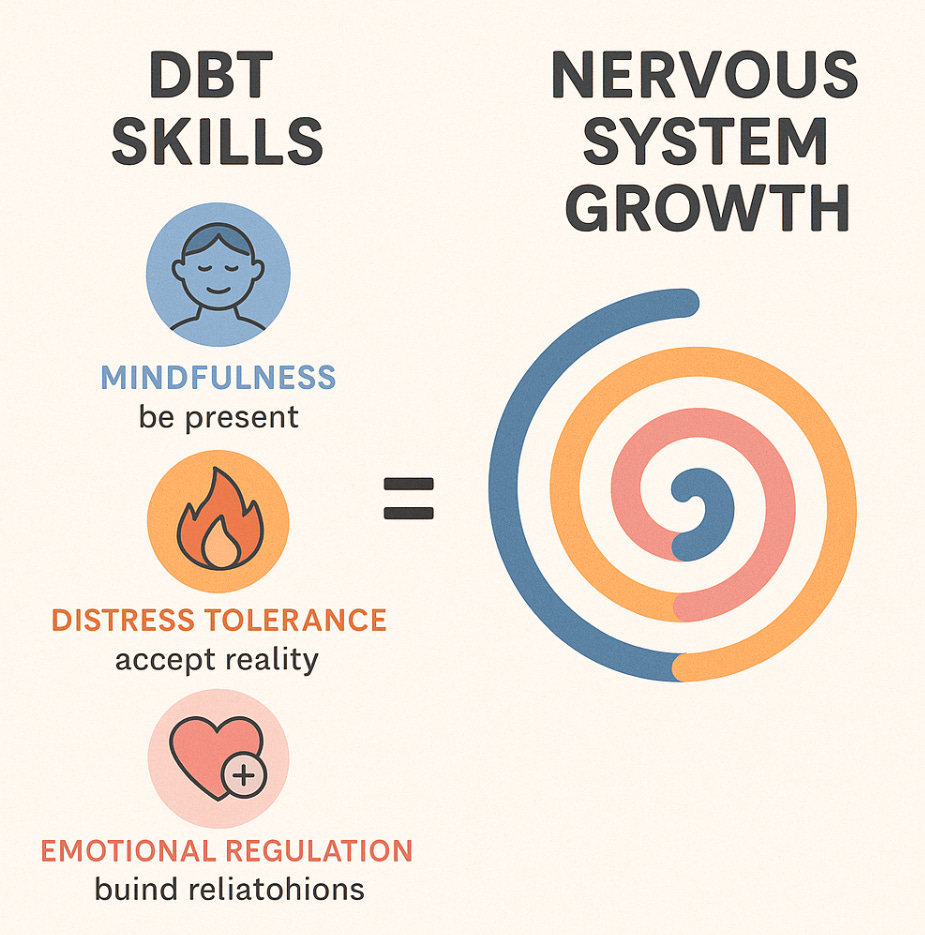
In short, it means starting with small actions (habits) and building those up (spiral) to be able to hold uncertainty, discomfort, nuance (both/and/all) while remaining safe within your own system (mind, body, nervous system).
DBT offers a lot of options for engaging in this process to build a healthier nervous system. So, I thought it would be great if we all got a crash course in what exactly DBT is so we can all understand how it can be effective for us, even if we’re not in a traditional DBT program, or not engaging in therapy at all.
I want to assure you; EVERYONE can benefit from learning DBT skills and applying them to their own life. In fact, we would ALL be better off if more people did learn DBT skills and applied them to their own life.
Now, what in the world is DBT?
First, DBT stands for Dialectical Behavioral Therapy. DBT is a cognitively based treatment. It is a type of talk therapy that combines cognitive- behavioral techniques with mindfulness practices. DBT is based on cognitive behavioral therapy (CBT) but has been specifically adapted for individuals who experience intense emotions, so for that reason it has been said to be an emotionally based treatment, as well. It focuses on helping people accept the reality of their lives and behaviors while also learning to change their lives, including their unhelpful behaviors. DBT is effective for treating and managing a wide range of mental health conditions, including borderline personality disorder (BPD), selfharm, suicidal behavior, PTSD, substance use disorder, eating disorders, depression, and anxiety and/or problematic (learned, unhelpful, patterned but not effective) behaviors.
Reconciling Contradictory Thoughts
In Dialectical Behavior Therapy (DBT), dialectics refers to the concept of reconciling contradictory thoughts, emotions, and behaviors. It emphasizes the coexistence of opposites, such as acceptance (validating one’s experiences, as is, as they are) and change (making positive adjustments to manage emotions effectively, in healthy ways). Marsha Linehan, the creator of DBT, describes dialectics as a synthesis of opposites, meaning two opposing truths can exist at the same time. This approach helps people navigate internal conflicts and promotes personal growth by integrating these opposing perspectives into the same frame.
All or nothing thinking prevents us from being dialectical. Folks spend a lot of time in all or nothing, black or white, this or that ways of being and seeing the world. Telling themselves, and others, that it has to be this way or that way. Dialectics says you don’t have to choose; it can be both, at the same time. While this opens up a wider reality, this kind of nuance (or living in the gray) makes many very uncomfortable. But absolutes aren’t realistic, so we have to get comfortable with the uncomfortable. DBT (and building healthy habits) helps us do that.

Validation
Validation is the main intervention in DBT. Self-validation and other-validation are necessary to create change; validation of your feelings, experiences, reactions is what lays the groundwork for change. If we can’t first recognize, name, and accept our experiences as real and true for us then building new skills to manage those experiences (in better, more effective ways) is not likely. Invalidation can be experienced as judgments, minimizing emotions, and/or ignoring experiences. Learning to validate yourself is a great place to start in strengthening that muscle to extend validation out to others, which means not judging them, not minimizing their emotions, and not ignoring their experiences, either.
MindFULness Skills
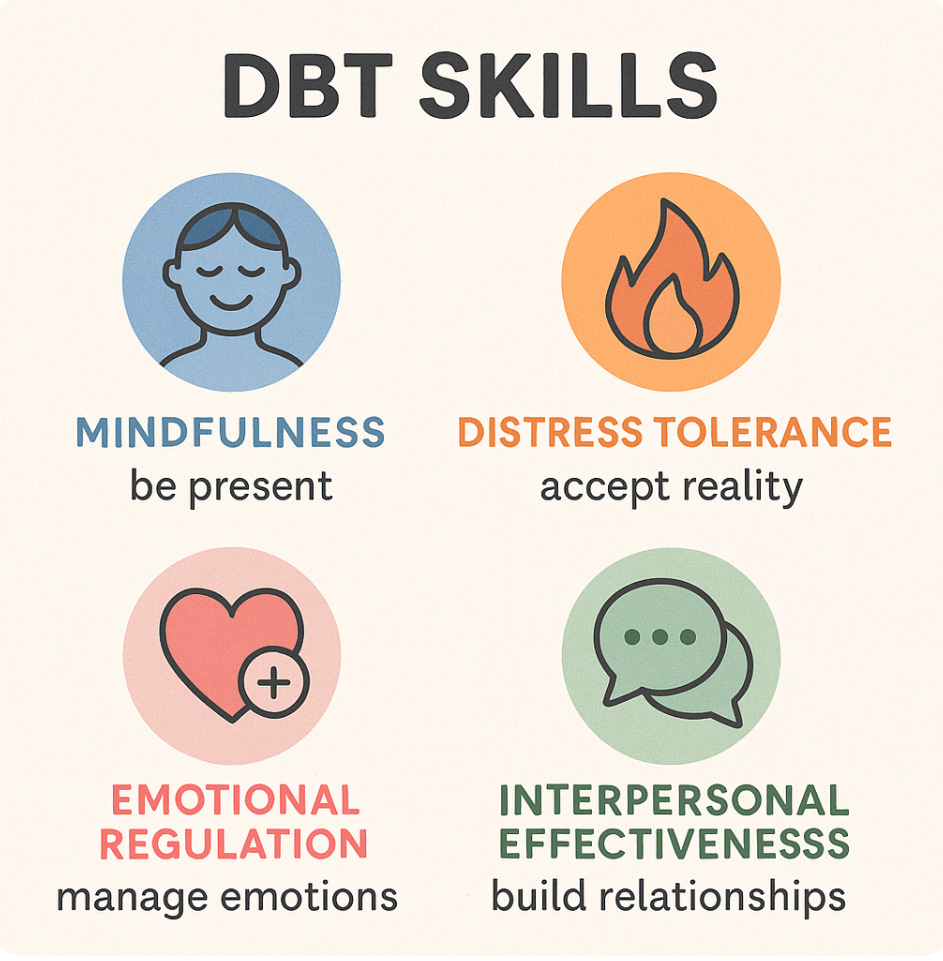
Mindfulness skills are the foundational skills in DBT. To be mindful is to be aware. To practice being mindful one must observe, describe, participate without judgment. That is to observe your emotions, describe what they are like, and to do so without judging yourself for how you feel. Observe your experience, describe what it is like, and to do so without judging yourself for how you reacted/responded to that experience. Mindfulness is noticing. Noticing and naming.
MindLESSness Awareness
The opposite of mindfulness is mindlessness. This is avoiding the present moment by rejecting, suppressing, blocking and/or being on autopilot. Everyday mindfulness means letting go of judgments and attachments—judgments about the unfamiliar and attachments to the familiar. The goal with mindfulness is to experience reality as it is, reduce suffering, and increase joy. We can’t really do any of those without awareness. Learning to remain present (especially when uncomfortable) is a skill. It’s a good thing skills can be learned and practiced to reach proficiency!
There are three (3) additional skill sets that encompass DBT: Interpersonal effectiveness; Emotional regulation; Distress tolerance.
Interpersonal effectiveness skills are used to help make and maintain healthy relationships. This includes making or maintaining healthy relationships (interactions at least) with people you don’t like, disagree with, have to work with, or have to follow directions from, not just people you are comfortable around. Self-respect is a cornerstone of being effective interpersonally. Self-respect means being grounded in one’s own priorities, goals, and values. How do I want to feel about myself when this interaction is over? Self-respect encourages us to pause and consider what we’re doing and determine if, indeed, it is effective. If these skills are not working, then you may need to ask yourself, “Are my short terms goals getting in the way of my long-term goals?” And then reconsider what skills to use to put yourself back on track to reaching your long-term goals in relationships with other people.
Emotional Regluation Skills
Emotional Regulation skills are used to reduce emotional suffering, understand and name emotions correctly, and decrease emotional vulnerability (things that kick up intense emotions). This means learning what situations to avoid walking into unprepared; ones that are likely to ignite big emotions (decrease vulnerability). This means paying attention to yourself and differentiating when you feel different emotions, and learning to name those emotions accurately (understand your emotional experiences). This means using effective strategies to manage and cope with intense or uncomfortable emotions. This means using skills that help soothe the discomfort on the front end, without causing consequences on the back end (reduce suffering). We can do things like accumulate positive emotions, build positive experiences, cope ahead (plan ahead to cope, give yourself options, or make a plan before walking in to avoid being unprepared to manage any emotion that arises). ACE (accumulate positive emotions, build positive experiences, and cope ahead) is a DBT skill.

Distress Tolerance Skills
Distress tolerance skills help us accept reality and reduce emotional arousal. They are skills to find short term solutions for painful situations, that don’t cause harm or negative impact, now or later. The idea is to use effective skills to help us weather the intensity of emotions, otherwise our default patterns will take over. These are often not helpful patterns, just things learned to survive. We want to be able to manage our emotions while not causing physical or emotional harm to ourselves, or to other people; to do so requires skills. Learning to tolerate distressing moments without acting on urges that either make tolerating the distress more difficult, or produce negative outcomes or consequences is a game changer for your nervous system balance.
Crisis survival skills are skills to help us tolerate the distress caused by a crisis situation. Contingency management strategies are used to change behavior. This means reinforcing skillful responses while decreasing maladaptive patterns. (Hey look, it’s a dialectic right here!). This means we have to find a way to survive the crisis, skillfully in the present moment AND avoid falling into default patterns that helped us survive in the past. Yes, this is essentially two things at the same time. And this what distress tolerance skills help us do.
How DBT Teaches Critical Thinking
DBT says there are four (4) possible responses to any problem: solve the problem, change your emotional reaction to the situation, stay miserable, radically accept the situation—“It is what it is” is a phrase to radically accept whatever is there. We can use skills to change our emotional reaction and/or radically accept the situation as is, even if we don’t like it. The alternative? Pain and nonacceptance. What does pain and nonacceptance lead to? Suffering. Struggling. Isolating. And more pain. Acceptance of what is, regardless of how you feel about it, is how we move from a life of suffering to a life of joy. Learning to accept what is requires skills! When we come up against something we don’t like, something that makes us uncomfortable, or something that activates our nervous system effective strategies is what gets us through…with as little harm as possible. As little harm as possible to us, and as little harm as possible to others.
DBT skills are really excellent for helping us cope with intense emotional patterns that cause disruptions in relationships. If you notice big emotions in yourself, then taking some time to learn, and practice, some DBT skills could possibly irrevocably change the interactions and outcomes you have with other people.
Download the app for daily signals to help you learn, and practice, some DBT skills!